RTH2290 and RTH3291 Syllabus

Instructor: Jessica Donahue B.S.R.T. (R)(T)(ARRT) Office: Rm 22
Telephone: 952-777-4884
Office Hours: please call or email to make an appointment E-Mail: jdonahue@nwhealth.edu
Department: Radiologic Sciences
Department Chair: Julie Beaudoin, MBA, R.T.(T)(ARRT)
The COVID-19 pandemic has highlighted the need for personal responsibility to support public health, including students, faculty, and staff on-campus. In order to keep our campus open for valuable in- person learning, everyone is expected to practice all campus-based precautions: Wear a mask. Keep your hands clean. Maintain social distance of 6 feet wherever possible. Stay home if you are sick.
Mask-wearing has been shown to limit the spread of COVID-19 and as of July 25, Executive Order 20-81 requires people in MN to wear a face covering in all public indoor spaces unless alone. Everyone is required to wear a mask on campus until further notice. Anyone refusing to wear a mask will be asked to leave campus immediately. Due to limited class sizes and other COVID-related restrictions, there will be no opportunity to make up in-person coursework that is missed due to non-compliance. No mask, no presence, no credit.
If a student must be quarantined due to COVID-19 exposure, they are still expected to fulfill all online course requirements. Opportunities to make up on-campus activities will be arranged with faculty.
Short-term leaves of absence are available for students who are too ill to participate in remote activities. Healthcare provider documentation may be required prior to approval of short-term leave of absence.
In order for students to learn effectively, it is critical for basic needs such as having food to eat and a safe place to live to be met. Any student who has difficulty affording groceries or accessing sufficient food to eat every day, or who lacks a safe and stable place to live, and believes this may affect their performance in their courses, is urged to contact the resources below.
If you are facing food insecurity, The Student Affairs Office offers a food pantry that can be accessed by any student needing assistance. The food pantry is located in the Student Organization Center next to the Student Affairs office. Additional food assistance can be requested through The Student Emergency Food Fund: https://www.nwhealth.edu/current-students/student-emergency-food-fund/
If you are having trouble paying rent or facing housing insecurity, the following organizations can provide assistance: http://www.mnhousing.gov/sites/np/renters
For assistance with landlord-tenant matters in Minnesota, contact Home Line (https://homelinemn.org/) at 612-728-5767.
A Community Relief Fund is also available to provide students with emergency assistance due to unforeseen circumstances. Students can request funding for emergency situations by submitting the following form: https://nwhsu.wufoo.com/forms/p1boktaz0cchwcs/
If further assistance is needed in the areas above, students are encouraged to contact Anthony Molinar, Dean of Students, for further assistance at amolinar@nwhealth.edu or 952-887-1381.
Course Catalog Description: Content and clinical practice experiences are designed for sequential development, application analysis, integration, syntheses, and evaluation of concepts and therapies in radiation therapy. Through structured sequential assignments in clinical facilities, concepts of team practice, patient-centered practice and professional development shall be discussed, examined and evaluated.
Prerequisites: All didactic coursework needs to be completed prior to enrollment in RTH2290 and RTH3291.
University Learning Outcomes: (ULO)
The Institution-wide learning goals define the common ground that unites the programs within the University. They are purposefully broad so that the various colleges and schools can continue to develop their unique identities through varying ways in which the goals are met.
- Communication
Graduates will demonstrate effective verbal, non-verbal, and written communication skills in a wide variety of contexts, including collaborative activities.
- Critical Thinking
Graduates of Northwestern will acquire the skills to effectively apply evidence based knowledge for personal growth and continuing professional development.
- Health and Wellness
Graduates of Northwestern will recognize the factors that influence health and well-being in both personal and professional situations.
- Ethics
Graduates of Northwestern will demonstrate integrity by using ethical and professional behavior in all endeavors.
- Civic Engagement
Graduates of Northwestern will promote the quality of life in the larger community through advocacy and community outreach with respect for diverse perspectives and people.
Associate of Science in Radiation Therapy Program Learning Outcomes (PLOs)
In addition to meeting the University Learning Outcomes, a graduate of the Associate of Science in Radiation Therapy program at NWHSU will be proficient in the following areas:
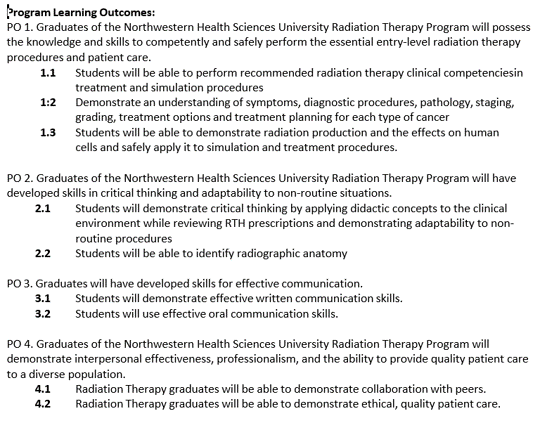
Course Objectives
Upon successful completion of this course, students will be able to:
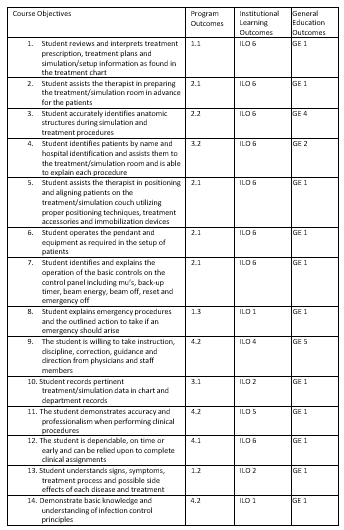
Course Format / Method of Instruction
This course is designed in a nontraditional format. This means that all required activities are completed online. Any clinical training materials can be found within your Moodle course shell. Due dates for all assignments are included in this syllabus as well as the current term lecture schedule. Students are expected to follow the provided schedules and submit all materials following published due dates.
Due to the use of technology within the design of this course, course completion requires that some of your student directory information, specifically your name and email address, will be displayed to other students registered for this course. If you have concerns about the display of your name and/or email address, please contact me or the Registrar for further information.
Out of Class Requirements / Study Time
Students can expect 15 hours of instructional engagement for every 1 semester credit hour of a course. Instructional engagement activities include lectures, presentations, discussions, group-work, and other activities that would normally occur during class time. Instructional engagement activities may occur in a face-to-face meeting, or in the eclassroom.
In addition to instructional engagement, students can expect to complete 30 hours of outside work for every 1 semester credit hour of a course. Outside work includes preparing for and completing readings and assignments. Such outside work includes, but is not limited to, all research associated with completing assignments, work with others to complete a group project, participation in tutorials, labs, simulations and other electronic activities that are not a part of the instructional engagement, as well as any activities related to preparation for instructional engagement.
At least an equivalent amount of work as required in paragraph above shall be applied for other academic activities as established by the institution, including laboratory work, internships, practica, studio work, and other academic work leading to the award of credit hours.
Required Texts and Materials: All previous books used for RTH course material will be helpful during Clinical Education
Recommended Texts and Materials
None
Course Requirements/Expectations
Check NWHSU email regularly for any course announcements.
- Read required materials prior to class.
- Complete and submit all assignments in a timely manner.
- Spend sufficient study time outside of class to keep current with class load.
- Undergraduate level written communication.
- Submission of original work for any assignments following copyright laws.
- Active participation in class activities.
Attendance & Participation
Radiation Therapy Program Attendance Policy –
(NWHSU Attendance Requirements differ from the program attendance policy. Please see student handbook for NWHSU policies)
- Tardies: If you are more than 10 minutes late, it will be recorded as an absence. If you are less than 10 minutes, it will be recorded as a tardy. The definition of tardy is “not in your seat when class begins.” The indicated time on a cell phone is the time that will be used. Two tardies are comparable to one absence.
- Absences: After two absences (or any combination of tardies + absences), you will receive a written warning from your instructor. A copy of that warning will be placed in your file for the duration of the program. Each subsequent absence (or combination of tardies + absences) will result in a 5% reduction in your final grade. For example, if you are absent a total of four times, your final grade is reduced by 10%. After 7 total absences (25% grade reduction), it would not be possible to pass the class. These numbers are based on a class that meets twice per week. In a class that meets once per week (including labs), the grade reduction will occur if there is more than one absence. The tardy policy applies to both situations.
- If you are absent from class, it is your responsibility to obtain the missed material from the instructor or another classmate.
- Exceptions to these policies will only occur in extreme situations where there is adequate documentation. Inclement weather and doctor’s appointments are not considered extreme situations.
Assignments / Assessments
Grading requirements
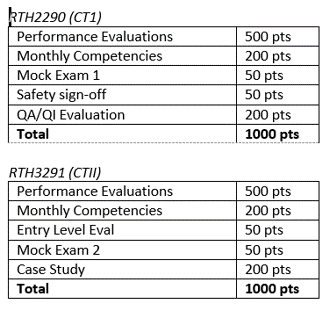
Grading
Grades are assigned according to the following scale:
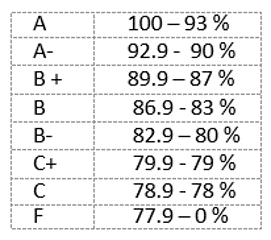
The assignment of and changes to course grades are the sole responsibility of the instructor of record. A grade may be changed only if there was an error in calculation. If you believe there has been an error in the calculation of a grade, contact the instructor for an explanation of the grade within the first week of classes the following term. If a grade is determined to be in error, a grade change report will be issued to the Registrar’s Office.
Exam/Assignment policy:
Email – Students are expected to review email (your NWHSU email account) daily. Your instructor may send updates or changes to your class assignment for the next class. You will be held accountable for these changes.
Cell Phone Use Policies
The use of cellular phones in any manner is prohibited in all classrooms and laboratories when class is in session. Cellular phones should be turned off or the ringer silenced prior to the beginning of each class session. Cellular phones must be turned off during examinations.
Professional Expectations
Students must follow policies and procedures as outlined in the University Student Handbook as well as the Radiologic Sciences Student Handbook.
Writing Support Services
All Northwestern Health Sciences students are eligible for free, one-to-one conferencing at the Writing Lab. Library staff provide help at every stage of the writing process, including researching, drafting, revising, incorporating sources, and learning to proofread and edit. Consultations are available on an individual basis.
To make the best use of the Writing Lab, visit far enough before a paper is due to allow yourself time to revise your work after your consultation. You can make an appointment or drop in the library to see whether a consultant is available. To schedule a time, contact the Writing Lab at library@nwhealth.edu.
Help Desk
NWHSU Help Desk (952-888-4777 x357 is available M-F 8am-4pm if you require assistance with technological aspects of this course.
Students with Disabilities
“The University will not, because of disability, deny qualified persons access to, participation in or the benefits of any program or activity operated by the University. Academically and technically qualified persons shall receive appropriate accommodations to ensure access to educational opportunities, programs and activities of the University.” (http://www.nwhealth.edu/staffairs/services.html). Students who need accommodations should contact University Counselor for special aids and services. To schedule an appointment with the University Counselor, call Student Affairs office, ext. 405, or send e- mail to Lori Hanegraaf at lhanegraaf@nwhealth.edu.
**Please be responsible and hand the request form to the instructor well in advance to schedule a test or an exam at the Student Affairs. Unless exceptional circumstances, failure to do so could delay the testing and the instructor or student affairs would not be responsible.
Drop / Withdrawal Dates
Last day to drop this course: 1/15/21
Last Day to withdraw from this course: 3/5/2021
Course Schedule Assignment Table
Student is required to work with their clinic supervisor to map out their individual rotations based on the clinics ability to provide the best progression through the program.
Please see the Clinical Training Handbook for all applicable due dates.
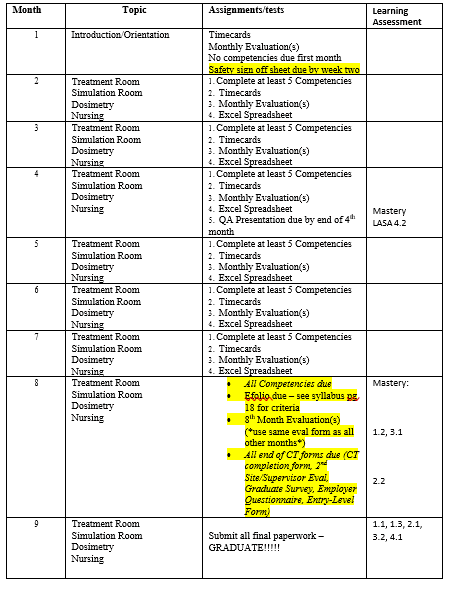
*A more detailed version of this schedule for the current term is available in the course website
This schedule of lecture and lab topics and quizzes and exams may be changed during the course of the trimester as circumstances require. Whenever possible, such changes will be announced in class before the date and time in question. You are responsible for anything that transpires during lectures and labs, even when you are unable to attend. In the event that you miss a class session, make sure you check with a classmate about any announcements or schedule changes which may have been made. Makeup exams are allowed only according to the policies described in this syllabus as well as the current University student handbook, which is available online and in the Student Affairs office.
Learning Assessment Clinical Training I
The following program learning outcomes will be assessed in this course at the Mastery level:
2.1 Students will demonstrate critical thinking by applying didactic concepts to the clinical environment while reviewing RTH prescriptions and demonstrating adaptability to non-routine procedures
Quality Assurance Evaluation
Quality assurance and quality improvement programs are a necessary part of maintaining a culture of safety within your department. This does not just have to do with the technical aspects of radiation therapy, but also things like patient and employee satisfaction. In a 3-4 page APA format paper discuss the following points:
- Using your Washington & Leaver textbook, define and research the role of quality assurance and quality improvement in healthcare.
- Discuss a current QA/QI program at your clinical site: what is the purpose and expected result?
- Are there any challenges in implementing and maintaining this QA/QI program?
- How does this effect patient and employee satisfaction?
- Explain the role of each part of the radiation oncology department in this QA/QI program. (treatment team, dosimetry, nursing, physics, etc.)
- Who is responsible for tracking these results?
- How are updates/changes communicated within the department?
- If you do not have a good example of a current situation, then create your own - what do you think should be implemented in your department to improve overall quality of patient care?
- What is your opinion of the effectiveness of this QA/QI program? Is there room for improvement?
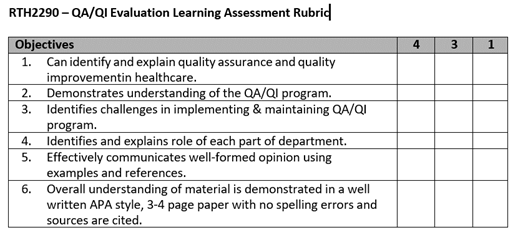
Note: If a component is absent, student receives a zero for that component
4 = Proficient – the objective was fully covered
3 = Satisfactory – the objective is mostly covered
1 = Unsatisfactory – objective is not covered
Score:______/24
Comments:
Instructor: _____________________________________